How ATC Mechanisms Influence Telescopic Cover Design in B-Axis Turning-Milling Machines
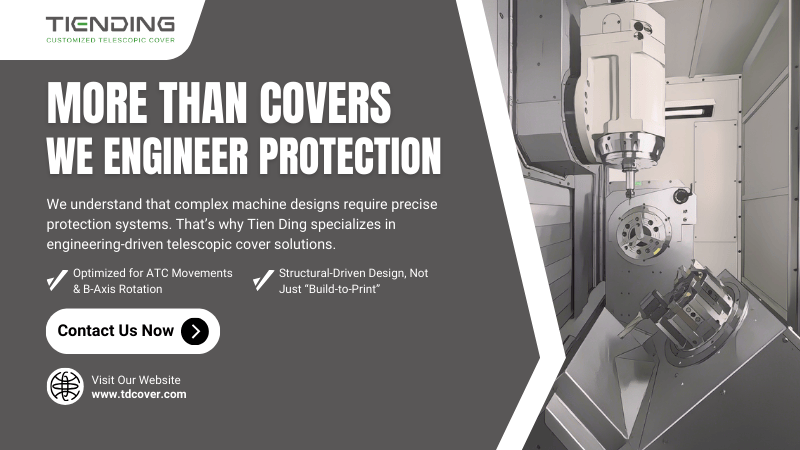
Why Horizontal ATC Layouts Are the Most Cover-Friendly
In modern turning-milling centers, the automatic tool changer (ATC) has a major influence on machining efficiency, tooling workflow, and overall machine performance. Engineers often focus on tool-change speed, arm motion, magazine capacity, and spatial layout—but what is frequently overlooked is the ATC’s direct impact on the design, motion logic, and durability of telescopic covers.
At Tien Ding Industrial Co., Ltd., we have seen repeatedly that the ATC configuration affects far more than the tool-change mechanism itself. It shapes the available space for telescopic covers, determining how they move, how long they last, and how effectively they protect guideways, motors, and internal machine structures.
This article examines why ATC mechanisms—especially horizontal ATC systems—play a critical role in telescopic cover engineering and what machine builders should consider early in the design phase.
Horizontal ATC Systems: The Most Cover-Friendly Design
1. Optimal for Vertical Enclosure Design and Space Efficiency
With a horizontal ATC, the telescopic cover can adopt a vertical enclosure layout, allowing the cover to fold or travel horizontally without interfering with ATC arm motion. This provides:
-
Minimal spatial conflict between the ATC and the cover
-
More freedom for reinforcement and structural optimization
-
Better serviceability for technicians accessing the side panels
-
Improved rigidity due to a simplified bending geometry
This configuration naturally gives designers more room to engineer a durable telescopic cover or way cover with long-term reliability.
2. Superior Chip and Coolant Management
The vertical layout of a horizontal ATC creates a natural gravity-assisted drainage path. Chips and coolant fall away from the sliding joints of the telescopic cover rather than accumulating on top of the panels.
This results in:
-
Reduced contamination buildup
-
Lower maintenance frequency
-
More stable sealing performance
-
Longer lifespan of the cover’s scraper system
For multi-axis machining centers, effective chip evacuation is essential to prevent premature wear of machine covers.
3. Minimal Impact on Stroke Logic and Structural Overlap
One of the greatest engineering advantages of a horizontal ATC is that its arm motion is perpendicular to the movement of the telescopic cover. This allows engineers to design:
-
Optimal stroke length
-
Ideal overlap ratios
-
Balanced plate thickness
-
Reinforcement distributed purely based on mechanical needs
The result is a more reliable, longer-travel telescopic cover with fewer mechanical constraints and lower long-term maintenance requirements.
Engineering Trade-Offs of Horizontal ATC Systems
While advantageous for telescopic cover design, horizontal ATCs introduce other engineering considerations:
-
Magazine scalability limitations — expanding tool capacity increases lateral width
-
Larger machine footprint — production lines may require more aisle spacing
-
Higher frame cost — structural requirements are more demanding than vertical ATC frames
These trade-offs are common in multi-axis systems, where design freedom for telescopic covers increases but machine footprint must be carefully managed.
Engineering Insight from Tien Ding Industrial Co., Ltd.
Tien Ding is more than a telescopic cover manufacturer—we are a collaborative engineering partner. Our expertise extends beyond fabrication and into:
-
Motion envelope planning and machine layout studies
-
ATC clearance evaluation
-
B-axis swing and spindle nose protection
-
Chip-flow and coolant behavior analysis
-
Load assessment and structural feasibility
Through this integrated approach, we’ve seen that the behavior of telescopic covers in a turning-milling center depends heavily on decisions made early in the ATC and enclosure design stages. A poorly matched configuration can cause:
-
Stroke interference
-
Seal degradation
-
Excessive wear in sliding zones
-
Unstable movement or misalignment
In contrast, early co-design ensures efficiency, stability, and longevity.
Tien Ding’s Value: Engineering Partnership Beyond Manufacturing
Tien Ding helps OEM machine builders optimize protection systems for next-generation platforms. Our support includes:
-
Identifying stroke conflicts and misalignment risks
-
Recommending optimized structural layouts based on motion simulation
-
Improving rigidity while achieving lightweight design
-
Ensuring long-term sealing performance
-
Reducing service complexity and lifecycle cost
By combining engineering consultation with manufacturing precision, Tien Ding ensures every telescopic cover contributes to improved machine reliability, not just protection.
Conclusion
Telescopic covers in modern multi-axis machine tools must achieve a delicate balance of protection, smooth operation, and long-term durability. The interaction between ATC mechanisms and cover design is often underestimated, yet it fundamentally shapes motion clearance, structural overlap, rigidity, and service life.
At Tien Ding Industrial Co., Ltd., we approach telescopic cover engineering not as isolated sheet-metal fabrication, but as part of a machine’s integrated motion system. By participating early in the design phase of B-axis and multi-axis machining platforms—especially those adopting horizontal ATC configurations—we help machine builders reduce interference risks, improve maintainability, and strengthen long-term operational stability.
If you are developing a new machining platform or optimizing an existing design, our engineering team is ready to collaborate. Tien Ding provides structural analysis, motion-range evaluation, and custom telescopic cover solutions that enhance machine reliability and performance. Contact us to explore how a well-engineered protection system can elevate your machine to the next level.
Frequently Asked Questions (FAQ)
Q1: Why does the ATC configuration affect telescopic cover design?
Because the ATC’s motion envelope determines the available space for telescopic covers or way covers to move safely. A mismatched layout can cause stroke limits, collision risk, or premature wear.
Q2: What are the main benefits of a horizontal ATC for telescopic covers?
Horizontal ATCs minimize interference, provide better chip-flow behavior, allow optimal stroke and overlap design, and improve long-term durability of telescopic covers.
Q3: How does Tien Ding ensure precision and reliability in telescopic covers?
By focusing on motion logic rather than static dimensions. We analyze stroke sequencing, overlap ratios, reinforcement, load distribution, and sealing behavior to create stable and reliable telescopic covers for CNC machines.
Q4: Can Tien Ding support co-development of protection systems for new machines?
Yes. We collaborate with OEM design teams from early stages to ensure the telescopic cover integrates perfectly with ATC motion, B-axis travel, and machine-tool architecture.
Q5: When should machine builders choose custom telescopic covers instead of standard way covers?
Custom telescopic covers are required for machines with long strokes, complex ATC movements, high coolant pressure, or multi-axis configurations where standard way covers cannot fully protect the system.
Catagory
Recent News
Key Engineering Considerations in Large Vertical Turning Lathe (VTL) Design
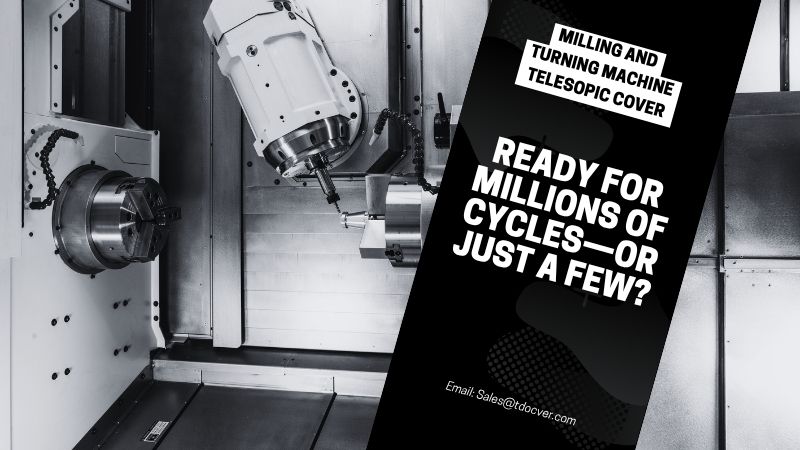
Why Telescopic Covers Must Be Involved Earlier in Turn-Mill Machine Design?