Why Telescopic Covers Must Be Involved Earlier in Turn-Mill Machine Design?
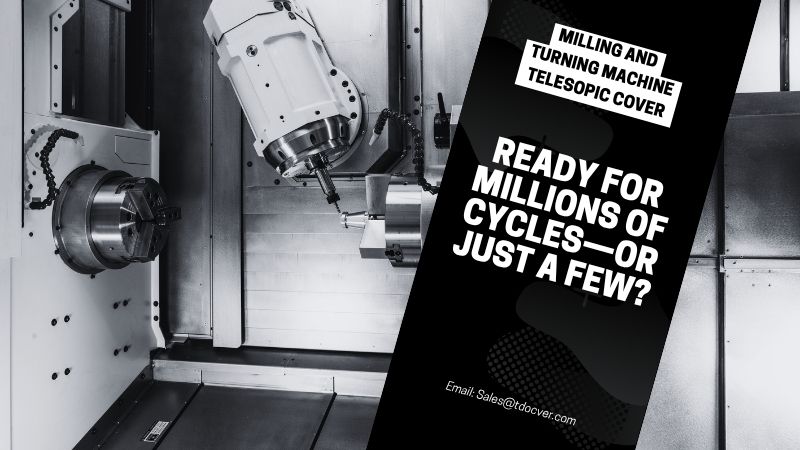
In the development process of high-end turn-mill machines, many machine builders typically finalize the main structure, casting layout, and core motion mechanisms before involving suppliers in the planning of telescopic covers and protection systems.
While this workflow may still function adequately for standard machine configurations, it often creates long-term risks in turn-mill machines, where multiple axes, complex motion paths, and highly compact internal spaces significantly increase the likelihood of interference, chip accumulation, accelerated wear, and difficult maintenance.
Based on Tien Ding Industrial Co., Ltd.’s extensive practical experience, the more complex the machine’s motion architecture becomes, the earlier the telescopic cover system should be integrated into the design process. In modern turn-mill machines, telescopic covers are no longer simple external protection components — they are closely connected to machine travel, chip management systems, coolant flow behavior, structural transitions, and maintenance accessibility.
Telescopic Covers Are Not Components Added at the End
Compared with standard 3-axis machining centers, turn-mill machines often involve simultaneous X-, Y-, and Z-axis movement, combined with B-axis swiveling, C-axis rotation, turrets, spindle heads, automatic tool changer (ATC) spaces, and highly complex cutting zones.
If telescopic covers are only considered after the machine structure has already been finalized, manufacturers commonly encounter problems such as:
- Insufficient installation space
- Restricted motion logic
- Unbalanced overlap ratios between cover segments
- Localized interference issues
- Reduced durability and service life
In many cases, what appears to be a “cover problem” is actually caused by earlier structural decisions. Examples include:
- Insufficient retraction space
- Poor chip guard positioning
- Excessive structural height differences
- Improper coolant return paths
These problems cannot be fully solved simply by modifying cover dimensions at a later stage.
For advanced turn-mill machines, telescopic covers should therefore be considered part of the overall motion and protection architecture from the earliest design stages — not treated as secondary accessories added after the machine layout is completed.
The More Axes a Machine Has, the Earlier Protection Systems Must Be Planned
This is one of the most critical — yet often underestimated — aspects of turn-mill machine development.
As the number of motion axes increases, the challenge is not simply “more movement,” but rather the exponential growth of:
- Interference conditions
- Motion envelopes
- Protection requirements
- Structural transitions
In multi-axis turn-mill systems, telescopic covers must accommodate not only machine travel, but also:
- Envelope changes caused by spindle heads, turrets, or B-axis movement
- Height transitions between adjacent structures
- Integration of chip guards, scrapers, and coolant guide surfaces
- Chip evacuation and coolant return paths
- Maintenance and assembly access requirements
If these factors are not evaluated during the early design stage, telescopic cover manufacturers are often forced to work within severe limitations later in the project. This not only reduces optimization opportunities, but also increases assembly trials, redesign costs, and production delays.
The Performance of the Chip Protection System Is Often Determined Before Casting Production Begins
In turn-mill machine platforms, chip protection performance is rarely determined after assembly. In reality, many of the key conditions are already fixed before the casting structure is even released for manufacturing.
This is because effective protection depends not only on the telescopic cover itself, but also on the coordination between multiple structural elements, including:
- Height differences between the machine bed and sliding structures
- Casting platform geometry and coolant drainage angles
- Interference between cover retraction zones and chip evacuation areas
- Transition quality between chip guards and telescopic covers
- Whether coolant tends to accumulate in joints or dead zones
If these details are overlooked during the early engineering phase, even highly precise telescopic covers may still suffer from:
- Chip accumulation
- Residual coolant retention
- Accelerated scraper wear
- Increased operating noise
- Reduced service life
In other words, the effectiveness of a turn-mill machine protection system depends not only on the quality of the cover itself, but on whether the machine structure was originally designed to support stable protection performance.
Structural Height Differences and Interface Design Directly Affect Long-Term Stability
In practical applications, many telescopic cover failures in turn-mill machines are not caused by insufficient material thickness or manufacturing precision. Instead, the root causes often lie in:
- Structural height differences
- Transition surfaces
- Incomplete interface design between adjacent components
Even relatively small structural offsets can eventually lead to:
- Poor segment folding behavior
- Unstable scraper contact
- Localized chip accumulation
- Uneven load distribution
- Progressive misalignment and wear over time
For multi-axis machines, the true challenge is not simply making the cover move — it is ensuring stable protection, chip evacuation, durability, and operational reliability under high-speed, multi-directional, and highly contaminated machining conditions.
This is why structural transitions and overlap details should ideally be discussed with the telescopic cover manufacturer before casting production officially begins.
Early Involvement of Telescopic Cover Suppliers Can Reduce Overall Development Cost
From a project management perspective, involving telescopic cover suppliers earlier in development does not complicate the process — it helps resolve problems before they become expensive.
If machine builders and cover suppliers jointly evaluate the following factors during the early stages:
- Motion envelopes and interference risks
- Cover retraction space
- Structural overlap ratios
- Chip guard layouts
- Coolant drainage direction and chip flow logic
- Installation and maintenance accessibility
many issues that would otherwise appear during final assembly can instead be solved at the design stage.
Compared with repeated sheet metal modifications, additional brackets, or redesigning machine structures later, early-stage integration is usually far more cost-effective and stable.
Tien Ding’s Perspective: Telescopic Covers Should Be a Co-Developed Engineering System
Tien Ding Industrial Co., Ltd. has long specialized in the design and manufacturing of telescopic covers / way covers for CNC machine tools. From our perspective, telescopic covers for turn-mill machines should never be treated as isolated components.
Instead, they should be considered part of a complete machine protection system, closely integrated with:
- Machine motion logic
- Chip management strategy
- Coolant flow behavior
- Structural transitions
- Interface geometry
Every one of these factors directly affects long-term stability, durability, and protection performance.
For advanced turn-mill platforms, the earlier telescopic cover manufacturers become involved, the greater the opportunity to establish a stable and optimized protection architecture — before structural limitations become costly problems.
Conclusion
For turn-mill machines, the timing of telescopic cover involvement is often more important than the cover type itself.
As machine structures become more complex and the number of motion axes increases, telescopic cover systems and chip protection strategies must be integrated earlier into the engineering process. In particular, structural height differences, chip guard layouts, coolant drainage paths, and casting interface details should ideally be finalized before engineering release and casting production.
A truly mature machine design approach does not wait until the main structure is completed before considering how to install the cover system. Instead, it treats the protection system as part of the machine architecture from the beginning.
Only through this approach can machine builders achieve the balance between:
- Machine performance
- Long-term reliability
- Maintainability
- Service life
If you are currently developing a next-generation turn-mill machine platform or optimizing an existing machine protection system, Tien Ding Industrial Co., Ltd. can assist with early-stage structural evaluation, space integration, and customized telescopic cover engineering to help establish a more stable and reliable machine protection solution.
Frequently Asked Questions (FAQ)
Q1. Why should telescopic cover suppliers be involved early in turn-mill machine development?
A: In turn-mill machines, telescopic covers are closely connected to machine travel, structural layout, chip evacuation, coolant flow, and maintenance accessibility. Early involvement allows potential interference, space limitations, and protection issues to be identified before casting and structural designs are finalized.
Q2. What problems can occur if telescopic covers are designed too late in the project?
A: Late-stage integration often leads to insufficient retraction space, interference between moving components, poor chip evacuation, unstable scraper contact, coolant accumulation, and reduced service life. In many cases, these problems cannot be fully corrected through cover modification alone.
Q3. Why are multi-axis turn-mill machines more challenging for telescopic cover design?
A: Multi-axis machines involve complex motion envelopes created by X-, Y-, Z-, B-, and C-axis movement, along with spindle heads, turrets, and ATC systems. This significantly increases interference conditions, structural transitions, and protection requirements compared with standard machining centers.
Q4. How do structural height differences affect telescopic cover performance?
A: Even small height differences between adjacent structures can cause unstable folding behavior, uneven loading, localized chip buildup, and long-term wear. Proper transition design is critical for maintaining stable motion and long-term durability.
Q5. Why is chip management closely related to machine structure design?
A: Effective chip evacuation depends not only on the telescopic cover itself, but also on coolant drainage angles, chip flow direction, structural overlap design, and the relationship between covers and chip guards. Many chip-related problems originate from early structural decisions rather than the cover alone.
Catagory
Recent News
Why Machine Travel Alone Is Not Enough for Telescopic Cover Design
Key Engineering Considerations in Large Vertical Turning Lathe (VTL) Design